
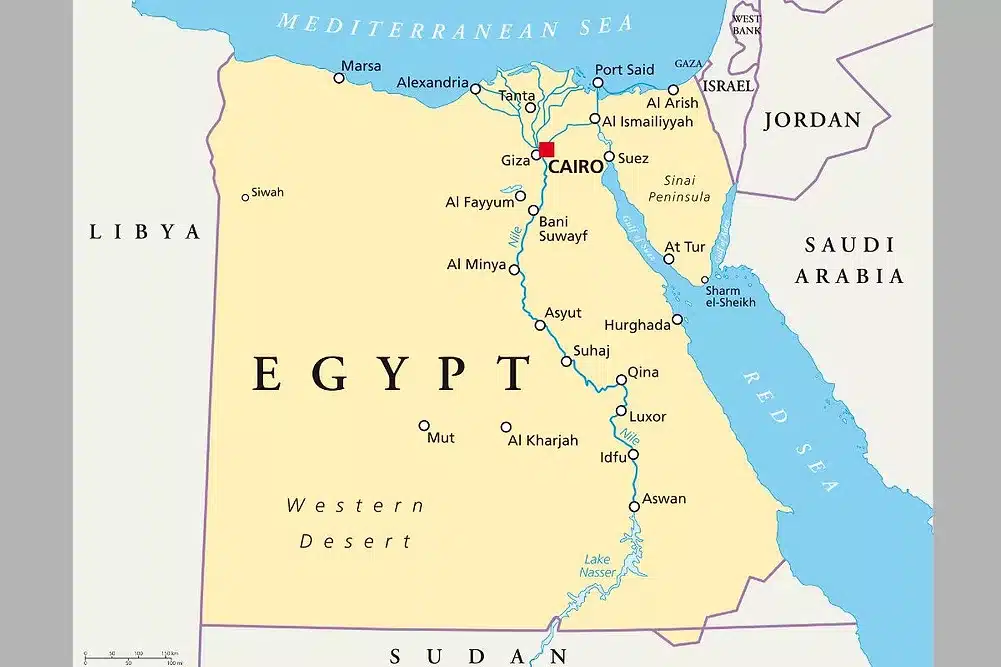
Egypt, one of the world’s top importers of wheat, saw its imports significantly drop in the first half of 2025 as the nation acclimated to a new state agency responsible for commodities procurement.
Media reports in December 2024 said the military-linked Future of Egypt for Sustainable Development took over procurement from the General Authority for Supply Commodities (GASC), which had been doing the job for decades.
Traders said this spring that the new agency didn’t have the proper requirements for doing business and relied on intermediaries, including local Egyptian importers. Suppliers were hesitant to work with the agency because of its lack of commodity trading experience. As a result, domestic wheat prices increased, and stocks dwindled.
Wheat imports in the first half of 2025 were down by more than 27% year over year to 5.2 million tonnes, while the government’s share of those imports dropped 57% to 1.5 million tonnes, according to news reports.
The Egyptian government said in July it had contracts for the acquisition of 3.4 million tonnes of wheat, 192,000 tonnes of crude oil, 4,000 tonnes of frozen poultry and 6,000 tonnes of frozen meat but did not give a specific timeframe. It also said the state wants to “diversify its sources for wheat imports to ensure the availability of adequate quantities and avoid potential crises.”
The government also announced in July plans to launch a revamped national commodity exchange to oversee imports and exports of agricultural products. The Future of Egypt will have a majority stake in the exchange, which will act as a “safety valve” for local markets.
Exporters and importers have started registering in the exchange and a draft law is being prepared, drawing on legislation from other countries with similar systems, according to a statement on President Abdel Fattah El-Sisi’s web page.
“This initiative is expected to boost food security and ensure the sustainable availability of essential goods at reasonable prices, balancing the interests of producers and consumers, while supporting the agricultural and industrial sectors,” it said.
Imports are critical to Egypt, where 2025-26 wheat consumption is expected to increase by almost 1.5% to 20.4 million tonnes, according to the Foreign Agricultural Service (FAS) of the US Department of Agriculture. Production is estimated at 9.3 million tonnes, up 1% from 2024-25.
Although only 3% of Egypt’s total area is arable, roughly 3.5 million hectares, the warm climate and abundant Nile water allow for several annual harvests. Main crops include corn, rice, wheat, sorghum, cotton, sugar cane and beet roots. Agriculture is an important sector of the Egyptian economy, contributing 13.7% to gross domestic product and employing 18.7% of the labor force.
Crop yields benefit from strict rotation and government controls on the allocation of area to crops, the varieties planted, the distribution of fertilizers and pesticides and marketing.
Agricultural exports also provide the country with an important part of its foreign exchange. Compared to other developing countries, Egyptian agriculture is geared toward commercial rather than subsistence production. Field crops provide about three-fourths of the total value of agricultural production with the rest coming from livestock, fruits and vegetables and other specialty crops.
Crop production, consumption
The 1% increase in wheat production is due to an increase in area harvested, which has been driven by higher procurement prices, the FAS said. Expanding wheat cultivation is difficult given limited water resources, land fragmentation, urbanization and competition from other winter crops, it said.
Total consumption is expected to increase in 2025-26 due to an increase in food, seed and food, seed and industrial (FSI) consumption. The FSI growth is primarily due to growth in the population, which is expected to increase from 107 million people to 124 million by 2030. The nation also has an estimated 10 million migrants.
Corn (maize) production is estimated at 7.25 million tonnes, an increase of 3.6% year over year, due to an anticipated increase in the area harvested, the FAS said. The positive outlook for poultry feed consumption will continue to encourage farmers to plant more corn during the summer.
Consumption is estimated at 15.8 million tonnes in 2025-26 on anticipated growth in the poultry sector, which is a major driver of feed and corn consumption. Egypt’s feed mills produce poultry feed with 70% yellow corn, 19.4% soybean meal, 3.4% wheat bran and 1.9% broiler concentrates, the FAS said.
Trade, subsidiesTrade
In a March 2025 report, the FAS estimated total wheat imports for 2025-26 at 13 million tonnes, with a significant amount coming from Russia. In the last five marketing years, the largest suppliers of milling wheat were Russia (34.6 million tonnes), Ukraine (10.4 million tonnes) and the EU (9.64 million tonnes).
Private sector mills that produce 87% extraction flour for the bread subsidy program are not allowed to produce the 72% extraction flour produced by other private sector mills. The other private sector mills produce European and white flat bread, which is non-subsidized, as well as baked products, cakes, biscuits, wafers, croissants and pastries. There are 5,000 private bakeries and patisseries producing these products, the FAS said.
Under Egypt’s Bread Subsidy program, each beneficiary receives 150 loaves per month or five loaves per day. Program participants pay 16% of the cost of production, with the government compensating the bakeries for the difference.
In collaboration with the World Food Program, the Egyptian government launched a new initiative this spring to fortify flour used in the subsidized bread with iron and folic acid. The fortified bread will be provided to 13 governorates with the highest rates of anemia.
During the past five years, private industry has increased its market share of wheat imports as it has increased its production of flour for exports and distribution to private bakeries, cafes and patisseries, the FAS said. The private milling industry became the major importer of US wheat. Since 2020, private sector imports of US wheat amounted to 527,148 tonnes used for milling high quality flour for various types of baked products.
Wheat flour exports in 2025-26 are estimated at 1.7 million tonnes (wheat equivalent), an increase of 20%, the FAS said. Egypt is a key supplier of flour to many African and Middle Eastern countries and has expanded exports to the region, especially in countries that saw conflicts and halted production capacities, the FAS said.
Top destinations the past five years have included Sudan, Eritrea, Yemen, Somalia, Djibouti, Syria and the Palestinian Authorities.
In addition to increased milling capacity, Egypt has been able to increase exports due to competitive prices and geographic proximity to these countries,” the FAS said.